When it comes to maintaining, repairing, or restoring the roof of your commercial or industrial building, choosing the right contractor is a decision that can have long-lasting consequences. A trustworthy, experienced commercial roofing contractor ensures your roof performs reliably—saving you time, money, and headaches down the road. Unfortunately, not all contractors are equipped to handle the complexities of commercial roofing, and hiring the wrong one can lead to a host of issues: missed problems, premature leaks, code violations, or even workplace safety incidents.
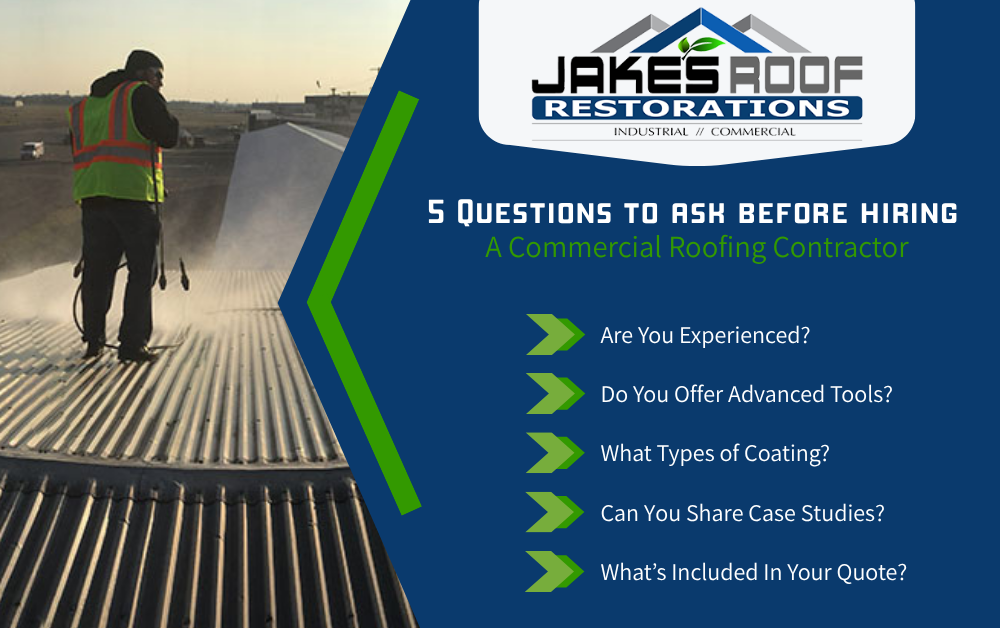
That’s why it’s essential to arm yourself with smart questions to vet potential contractors effectively. Here are five critical questions every commercial building owner or facility manager should ask before signing a contract—with insights into what makes Jake’s Roof Restorations a standout choice.
1. Are You Experienced with Commercial and Industrial Roofing?
Why this matters:
Commercial roofing requires a completely different skill set than residential work. These roofs use specialized materials like EPDM, TPO, PVC, built-up roofing (BUR), modified bitumen, metal panels, and coatings—each with its own unique installation and repair requirements. The scale and safety demands are also greater, often involving larger surface areas, taller buildings, OSHA-trained crews, lift equipment, and strict adherence to fall protection protocols. On top of that, many commercial systems must meet specific warranty guidelines and comply with industry or environmental standards such as LEED or ENERGY STAR.
What to look for in their answer:
-
Specific material experience: Ask if they’ve worked with flat roofs, membrane systems, metal panels, or spray coatings.
-
Certifications and training: Look for OSHA construction training, manufacturer certifications (e.g., Duro-Last®), or professional associations (e.g., NRCA membership).
-
Project examples: They should be able to cite projects similar in size or complexity to yours.
This demonstrates targeted depth—they aren’t just a residential shingle crew in work boots; they’re specialists in large commercial systems.
2. Do You Offer Infrared Leak Detection or Other Advanced Tools?
Why this matters:
Commercial roofs often conceal moisture beneath coatings or multiple membrane layers, making hidden leaks difficult to detect with standard inspection methods. That’s where infrared (IR) thermography becomes a valuable tool. By identifying temperature differences, IR technology can pinpoint trapped moisture without cutting into the roofing system—preserving warranties and avoiding unnecessary damage. This non-destructive testing allows contractors to catch problems early and take proactive steps before leaks lead to costly water damage.
What to look for:
-
Are they using infrared scanning, moisture meters, or drone inspection tech?
-
How do they present findings—via reports, annotated aerial photos, or detailed diagrams?
-
Do they bundle IR scans with quotes or require upfront payment?
By investing in these tools, Jake’s Roof Restorations shows they value precision, cost control, and clear communication—qualities that reflect high professionalism.
3. What Types of Coating or Repair Systems Do You Recommend—and Why?
Why this matters:
Commercial roofing is never a one-size-fits-all solution. A qualified contractor should tailor both the materials and the repair methods to fit the specific needs of your building. Different coatings—such as acrylic, silicone, or urethane—each offer distinct benefits, including UV resistance, flexibility, self-leveling properties, or the ability to withstand ponding water. Likewise, various repair options like peel-and-stick patches, liquid-applied membranes, or metal flashings are best suited for particular scenarios. Asking why a contractor recommends a certain approach not only clarifies the plan but also reveals their technical expertise and understanding of your roof’s unique conditions.
What to look for in their response:
-
An assessment of your roof’s age, substrate, pitch, and drainage.
-
Clear comparison of material options (e.g., acrylic vs silicone, built-up vs single-ply).
-
Justification for a choice based on performance goals (e.g., prolonging roof life, reducing energy cost, warranty extension).
This consultative, informed approach differentiates Jake’s from contractors who simply push a fixed product line.
4. Can You Share Case Studies or References from Similar Projects?
Why this matters:
Testimonials and past work provide real-world proof of a contractor’s capabilities—not just marketing claims. References give valuable insight into important factors like timeliness, communication, crew professionalism, pricing transparency, and the quality of post-completion support. For facility managers, hearing from peers in the same industry or region can be especially reassuring, and specific examples of similar projects go a long way in building trust and confidence in a contractor’s ability to deliver.
What to ask:
-
Do they have case studies on similar-sized facilities—warehouses, factories, commercial parks?
-
Can they provide local references (e.g., Banyan facility in Chambersburg, distribution center on I‑81)?
-
Are they licensed and insured in your state? Do they have local subcontractors or staff?
-
How did they handle surprises—unexpected damage, weather delays, warranty concerns?
This shows openness, confidence, and a willingness to let past customers “vouch” for them—an effective trust-builder in writing.
5. What’s Included in Your Inspection or Quote?
Why this matters:
A vague quote is a red flag when hiring a commercial roofing contractor. You should expect a clear breakdown of the project’s scope, timeline, materials, permitting needs, and warranty coverage. Hidden costs—such as tear-off disposal, replacement flashings, insulation repairs, or coordinating around high-traffic areas—can quickly inflate the final bill if they aren’t addressed upfront. That’s why a thorough inspection is so valuable. It should include an interior attic walk-through, infrared moisture mapping, and detailed testing, all summarized in a comprehensive written report that leaves no guesswork.
What the ideal answer sounds like:
-
“Our quote includes removal of loose debris, minor crack repairs, priming, coating application (X gallons), labor, drumming or roll-off disposal, and a 10-year manufacturer warranty.”
-
Clarified post-work clean-up, site protection, and storage.
-
Defined timing—when materials arrive, when applications are done, and whether work requires building occupancy disruption.
-
Post-job follow-up, such as inspection, maintenance plan, or annual touch-up options.
This level of detail reduces surprises and improves transparency, which builds trust before signing a contract.
Putting It All Together: How Jake’s Roof Restorations Measures Up
Here’s how Jake’s team helps clients judge contractors using these five questions:
| Evaluative Question | Red Flag Answer | Preferred Jake’s Answer |
|---|---|---|
| Commercial/industrial roofing experience | “We primarily do houses.” | “Certified for commercial membranes, coatings, with 14+ years in commercial job sites.” |
| Infrared or advanced inspection tools | “We learn as we go.” | “Infrared, moisture meters, aerial photos—standards for every inspection.” |
| Tailored system recommendations | “We only do silicone coatings.” | “We choose acrylic or silicone coatings or metal repairs based on roof type & condition.” |
| Local, relevant references | “Certainly, nationwide portfolio.” | “References along the I‑81 corridor—warehouse clients, facility manager referrals.” |
| Transparent inspection and quote details | “Price per square foot, materials not included.” | “Includes scope, prep, materials, labor, disposal, warranty, plus follow-up plans.” |
With clarity and attention to detail, facility managers can easily see why Jake’s Roof Restorations stands out compared to contractors who may be less specific or polished in their responses.
Why Asking the Right Questions Benefits You
-
Protects your bottom line – A thorough inspection and tailored repair strategy help prevent overspending on unnecessary work or being surprised by hidden costs later.
-
Maximizes your roof’s lifespan – Choosing a contractor with experience in coatings, leak detection, and maintenance ensures your roof performs reliably year after year.
-
Avoids operational disruptions – Professionals plan around your business’s needs and keep safety, access, and timing in check.
-
Ensures warranty protection – Mistakes during installation or repairs can void manufacturer warranties. Asking the right questions helps you avoid those risks.
-
Builds long-term trust – You’re not just hiring a crew—you’re choosing a partner for years of upkeep, repairs, and planning.
The Right Questions Lead to the Right Contractor
There’s a lot riding on the roof over your head—especially when that roof covers your business operations, equipment, and people. That’s why choosing a commercial roofing contractor isn’t just about price or availability—it’s about trust, experience, and proven performance.
At Jake’s Roof Restorations, we welcome your questions. We’re proud to serve businesses throughout the I‑81 corridor, from Harrisburg to Hagerstown and beyond. Whether you’re managing a manufacturing plant, warehouse, or commercial facility, our team is equipped to handle inspections, coatings, repairs, and long-term roof care with integrity and precision.
Ready to speak with a commercial roofing contractor who puts your needs first?
Contact us today to schedule an inspection and discover why so many building owners trust Jake’s for commercial roofing done right.